

In any democracy, the power belongs to the people. Through what philosophers call the social contract, citizens agree to be governed by leaders only because those leaders act on their behalf.
In Kenya, we don’t surrender our sovereignty when we elect Members of Parliament, we delegate it. Article 1 of the Constitution is clear: “All sovereign power belongs to the people of Kenya,” and it can be exercised directly or through democratically elected representatives. That means that MPs are not bosses (despite our habit of calling them ‘mkubwa’ or ‘mhesh’); they are employees of the people. And just like any employee, they are expected to consult their employer, that’s you, the citizen, before making big decisions.

Think of it like hiring someone to manage your business. You give them a job description and expect regular updates. You don’t expect them to ignore your calls, lock the office door, and then send you a bill for expenses you never approved. If they did that, you’d fire them.
So why do we tolerate it from Parliament?
MPs Work for Us
When Parliament debates and passes laws, they are shaping the rules that govern our lives, our money, our land, and our future. If they do this without listening to us, they are not doing their job. Public participation is not just a formality, it’s the legal and moral duty of government at all levels.
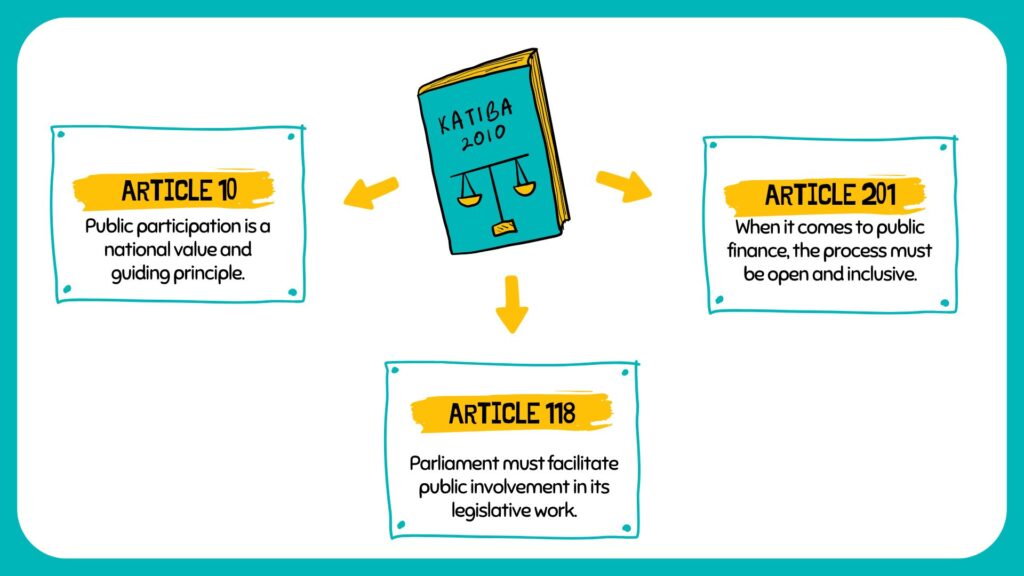
The Constitution of Kenya places a strong emphasis on public participation. Here’s what it says:
- Article 10: Public participation is a national value and guiding principle.
- Article 118: Parliament must facilitate public involvement in its legislative work.
- Article 201: When it comes to public finance, the process must be open and inclusive.
- The County Governments Act & Statutory Instruments Act: These laws extend participation obligations to all levels and types of lawmaking.
So no, it’s not a favour when Parliament invites us to give feedback. It’s the job. It’s a legal, constitutional duty. And when citizens step up to participate, they are doing exactly what the Constitution says they should.
Enter the “dangerous criminal”, Rose Njeri
Which brings us to the most bizarre twist in this civic drama. Rose Njeri, a private citizen, built a website that allowed ordinary Kenyans to read the Finance Bill and submit comments to Parliament. Which is absolutely brilliant, if you ask me! In other words, she did Parliament’s homework. For free. Using the internet. Like it’s 2025 or something.
And for this, she was arrested and charged under what must be the most abused law we have. You know it, the Computer Misuse and Cybercrimes Act.
Let that sink in.
The Constitution says public participation is mandatory. Parliament has a duty to involve citizens. Rose built a tool to help them do exactly that. But instead of thanking her, the government slapped her with criminal charges. That’s like firing your assistant for organizing your filing cabinet too well. Or arresting your domestic helper for sweeping under the bed.
If our MPs were overwhelmed by emails and comments from citizens, isn’t that proof that people actually want to be heard? Instead of criminalizing civic innovation, we should be rewarding it. Unless, of course, the real problem isn’t the method, it’s the message.
Arresting a citizen for helping Kenyans engage with a Bill that determines how revenue will be raised (read taxes) is not just unconstitutional, it’s comedic. Unfortunately, it’s the kind of comedy that leaves a bitter aftertaste. The joke, sadly, is on us.
She Had the Audacity to Demand
This post brings me back to a post I wrote a couple of weeks back, The Audacity to Demand, where I argued that challenging power isn’t a provocation, it’s patriotism. And Rose Njeri is proof of that. She didn’t give a fiery speech or storm any gates. Her form of protest, her little act of citizenship, was building a website.
That was her hummingbird moment.
You may have heard the story told by the late Wangari Maathai. As a massive fire consumes the forest, the animals flee, except for one tiny hummingbird. While others watch helplessly, the hummingbird flies back and forth to the river, carrying drops of water in its beak to put the fire out. When the other animals mock her, she replies:
“I’m doing the best I can.”
Rose Njeri did the best she could. She used her skills to help fellow citizens participate. And she reminded all of us that making noise, asking questions, and showing up, whether in the streets or through a screen, is how democracy survives.
The Bottom Line
You don’t stop being the boss after Election Day. Representation doesn’t cancel participation, it requires it. Public participation is not a box to tick. It is a constitutional right and a cornerstone of our democracy. When citizens speak, Parliament must listen.
And when a citizen builds a tool to help Parliament listen better? Arresting them is not only unconstitutional, it’s embarrassing.
Until the next doodle, stay curious!
