
Today being the International Anti-Corruption Day, I find myself reflecting on the issue of corruption. As a final year student at Kenyatta University School of Law (KUSOL), I found myself plunged into the world of anti-corruption advocacy, volunteering at Kenya’s leading anti-corruption watchdog, Transparency International – Kenya.


Lessons From the Field
Back then, my job was to teach citizens in the remote villages of Kwale and Kilifi about governance and accountability as per the Constitution of Kenya, and how they could use their power as citizens to hold their elected representatives accounable. Chapter 6 on leadership and integrity is the foundational provision that gives us the expectation of good leadership. Or representation, as I prefer to call it. On paper, as a country, we are very serious about integrity, or “maadili mema”, as we would say in Kiswahili. But kwa ground? Well, we all know how it is.
Why Are We Still Here?
So now I wonder, why is it that over a decade since I joined the anti-corruption and good governance movement, we still seem to be singing the same old song? Even after multiple exposés by talented investigative journalists, multiple whistleblowers shedding light on dark dealings draining the country of our much-needed resources, corruption is still a big issue that only gets bigger?


The Burden Always Falls on Citizens
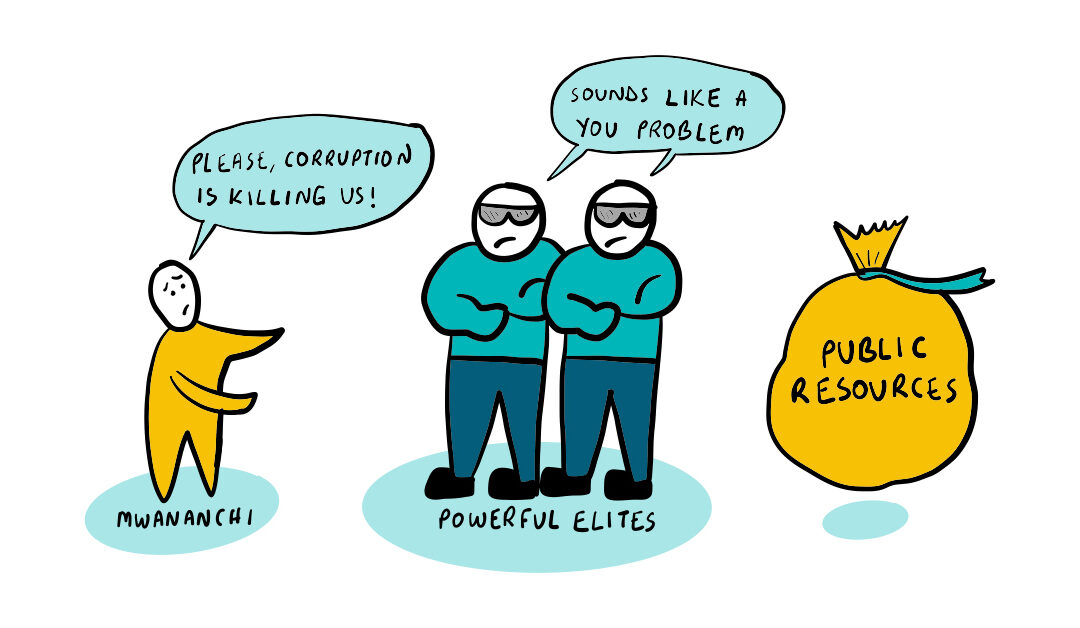
In this never-ending anti-corruption fight, I’ve noted that the emphasis always seems to be on the citizens to end corruption, rather than addressing the systemic root causes that allow corruption to thrive.
I find this year’s anti-corruption day theme to be specifically worrying as it places the onus of fighting corruption on the demographic that has suffered the most from it. “Uniting with Youth Against Corruption: Shaping Tomorrow’s Integrity” is a slap to the face to the youth, who, because of systemic corruption, have been denied basic rights such as access to education, have difficulty getting gainful employment, and when they try their hand at business, find themselves counting losses from all the regulatory hoops and harassment from public officers.
Corruption Is a Hydra
Like the mythological Hydra, corruption is the monster that refuses to die. Ordinary citizens (and now youth) are expected to go and chop off its heads one-by-one, only to realise that two more will grow in its place. As the story goes, the Hydra was finally defeated when Hercules came up with an idea; chop one head off, and immediately throw a flaming arrow at the stump, thus cauterizing the wound and preventing another head from growing.
Similarly, corruption is a beast that cannot be slain by a single blow. Because it is embedded in institutions, legal loopholes, financial secrecy and networks of patronage, it cannot be defeated by a single arrest, a token investigation, or periodic audits. It requires a systemic approach: structural reforms, transparency, accountability, participatory governance, financial oversight, civic engagement, protection for whistle-blowers, and a culture that rejects impunity. Only by destroying the the enabling institutions and networks can societies hope to prevent new “heads” from regenerating.


The Burden Belongs to Those in Power
On this International Anti-Corruption Day, the message needs to be clear: the burden of fixing corruption should not fall on the youth, or on ordinary citizens who already pay the highest price. It belongs to the governments, public officials, political elites, and private sector power brokers who design, protect and benefit from the systems that let corruption flourish.
Corruption survives because powerful people allow it to survive. It thrives because institutions are structured to shield wrongdoers, because accountability mechanisms are weak by design, because illicit financial networks operate with impunity, and because those entrusted with public resources treat them as personal assets.
Ending corruption is not about asking young people to fight harder. It is about holding leaders accountable, stripping away the protections that shield corrupt networks, and rebuilding institutions that put public interest above private gain.

Real Change Means Naming the Real Culprits
Real change begins with dismantling the foundations that allow it to thrive. And the youth should not be guilted into believing that it is their problem to solve. Let’s point fingers at the real culprits, the governments, institutions, and powerful people that created the systems in the first place. If governments are serious about shaping tomorrow’s integrity, they must prove it through action, not slogans or symbolism. The future of young people depends on leaders who choose courage over complicity and transformation over comfort. Only then can the hydra finally fall, and only then can youth inherit a society that was not stolen from them before they even had a chance to build it.
#UnitedAgainstCorruption #InternationalAntiCorruptionDay #VisualStorytelling #TheDoodlingLawyer #KnowledgeSimplified
Until the next doodle, stay curious!
The Doodling Lawyer.
